
McCormick County Arrest Records and Charges
McCormick County arrest records are tied to the arrest or booking event. They may involve the arresting agency, booking information, detention contact, warrant service, bond events, and releasable law-enforcement records. The county research found no official online McCormick County jail roster, booking database, or mugshot search on the sheriff, detention center, county forms, Sheriffs' Association, or Judicial Branch sources reviewed.
Court charge records begin when a criminal accusation is filed with the court. That record may show the offense description, statute number, CDR code, court, case number, bond information, and current charge status. The full criminal case file later adds pleas, motions, hearings, disposition, sentence, and post-judgment details. Use criminal court records for the full case outcome and inmate records for custody or jail lookup channels.
The official McCormick County Sheriff's Office page is the source for local arrest, records, warrant service, detention, and sex-offender contact information.
The Sheriff's Office provides the arrest-side access point, while filed charges and dispositions must be checked through court and prosecution channels.
Find McCormick Arrest Records and Charges
Start with the court system when the goal is court charges after arrest. The South Carolina Judicial Branch Case Records Search links to the McCormick Public Index for available trial and summary court case records. Use the CDR Codes lookup to interpret offense codes and statute references. For booking or custody status, the county's researched fallback is the Detention Center, Sheriff's Office records/support services, or FOIA where releasable.
- Search the McCormick Public Index after a case has been filed in court.
- Review available charge descriptions, statute references, CDR codes, bond entries, and case status.
- Use CDR Codes to interpret an offense code or statute citation.
- Contact the Clerk for General Sessions case copies or Magistrate Court for summary criminal, warrant, bond, or traffic matters.
- Call the Detention Center or Sheriff's Office for custody or booking questions that are not online.
SLED CATCH can provide a South Carolina name-based criminal-history search, but it is not a wanted-person search and does not replace a court case lookup. The research also found no McCormick sheriff or police app for arrest records, warrants, or booking searches.
For immediate custody questions, use the McCormick County Detention Center phone channels identified in the research. For a charge that has reached court, use Public Index, the Clerk, or Magistrate Court. For an active warrant question, do not rely on CATCH because SLED states wanted-person information is not included.
Charges Filed After Arrest
After an arrest, a charge record may begin through a complaint, an information, an indictment, or a warrant-related filing, depending on the court and offense. In McCormick County, Magistrate Court handles lower-level criminal matters, warrants, bond, and preliminary hearings. General Sessions handles more serious criminal matters in Circuit Court, and the Eleventh Circuit Solicitor prosecutes many of those cases.
| Complaint | Information | Indictment | |
|---|---|---|---|
| Filed By | Officer or prosecutor, depending on case type | Prosecutor | Grand jury |
| Common For | Summary or lower-level criminal matters | Some prosecutor-filed criminal matters | Serious General Sessions charges |
| Record Role | Starts or supports the court charge | States the formal accusation | Formal charge returned for prosecution |
South Carolina uses a Solicitor for prosecution. The Eleventh Circuit Solicitor serves McCormick County along with Edgefield, Lexington, and Saluda counties, and the Solicitor's public-record links page is a useful source for criminal-record channels.
The McCormick County Sheriff's Office may create or hold arrest-side information, but the prosecutor decides how many formal charges proceed and which court will receive them. A single arrest can produce no filed charge, one charge, or several separate charges. Each filed charge can then follow its own status path in the court record.
Charge Status Meanings
Charges can change after filing. A charge may remain pending, be amended, be reduced, be added to a case, be dismissed, be nolle prossed, or end in a conviction or not-guilty result. One arrest can produce several separate charges, and each charge may have its own status. Read the charge line with the disposition and docket entries before drawing any conclusion.
| Status | What It Means |
|---|---|
| Pending | The charge remains open and has not reached a final result. |
| Amended / Reduced | The original charge was changed, often through prosecutor review, plea negotiation, or court action. |
| Dismissed | The charge ended without a conviction on that charge. |
| Nolle Prosequi | The Solicitor declined to prosecute further, often shown as nolle prossed. |
| Guilty / Not Guilty | The charge ended in a conviction or an acquittal/not-guilty finding. |
Charges vs Convictions
A charge is not a conviction. It is the accusation filed after arrest, citation, warrant service, or prosecutor review. A conviction requires a guilty plea, guilty verdict, or other formal finding of guilt accepted by the court. McCormick County arrest records and court charge records may show accusations that never became convictions.
| Charge | Conviction | |
|---|---|---|
| Meaning | Formal accusation | Finding or plea of guilt |
| Timing | Early in the court process | At disposition or sentencing |
| Can disappear from public view? | May be sealed, restricted, or expunged where eligible | May be restricted or expunged only where law allows |
Note: A dismissed charge can still appear in a court record unless it is later expunged or otherwise restricted.
Sealed vs Expunged Records
Sealed records are hidden from ordinary public access but may remain under court control. Expunged records are destroyed, sealed, or removed from public access under an expungement order where eligible. The Eleventh Circuit Solicitor handles expungement requests for many General Sessions and Juvenile Court charges and eligible Magistrate or Municipal criminal conviction categories. Some dismissed, nolle prossed, or not-guilty summary court matters may be processed by the originating court.
| Sealed | Expunged | |
|---|---|---|
| Public view | Restricted from ordinary public access | Removed, sealed, or destroyed under an order |
| Main source | Court order, rule, or confidentiality statute | Expungement statute and court order |
| Eligibility | Depends on the record type and court order | Depends on charge, disposition, prior record, waiting period, and court type |
Charge Codes and Severity
South Carolina CDR codes help identify criminal and traffic offenses in court records. The official tool supports searches by CDR code, statute number, keyword, status, and printable versions. Captured status options include Active, Retired, and All. A code can help connect a charge description to a statute, but the code alone does not prove guilt, sentence, or final disposition.
Severity also depends on court jurisdiction. Magistrate Court generally covers lower-level offenses and summary criminal matters, while General Sessions handles more serious criminal cases. The Solicitor's materials define General Sessions as crimes carrying more than 30 days in jail and/or more than $1,000 in fines. Magistrate Court matters are described as misdemeanors up to 30 days and/or fines up to $1,000.
State Charge and History Lookups
SLED CATCH is South Carolina's Citizens Access to Criminal Histories portal. The research captured a name-based criminal history search that requires last name, first name, and date of birth, with optional SSN. The fee is $25 non-refundable plus a $1 online convenience fee. Mail-in requests avoid the convenience fee and are mailed to the SLED Records Department.
The SLED CATCH portal is an assigned source for McCormick County arrest records and court charges.
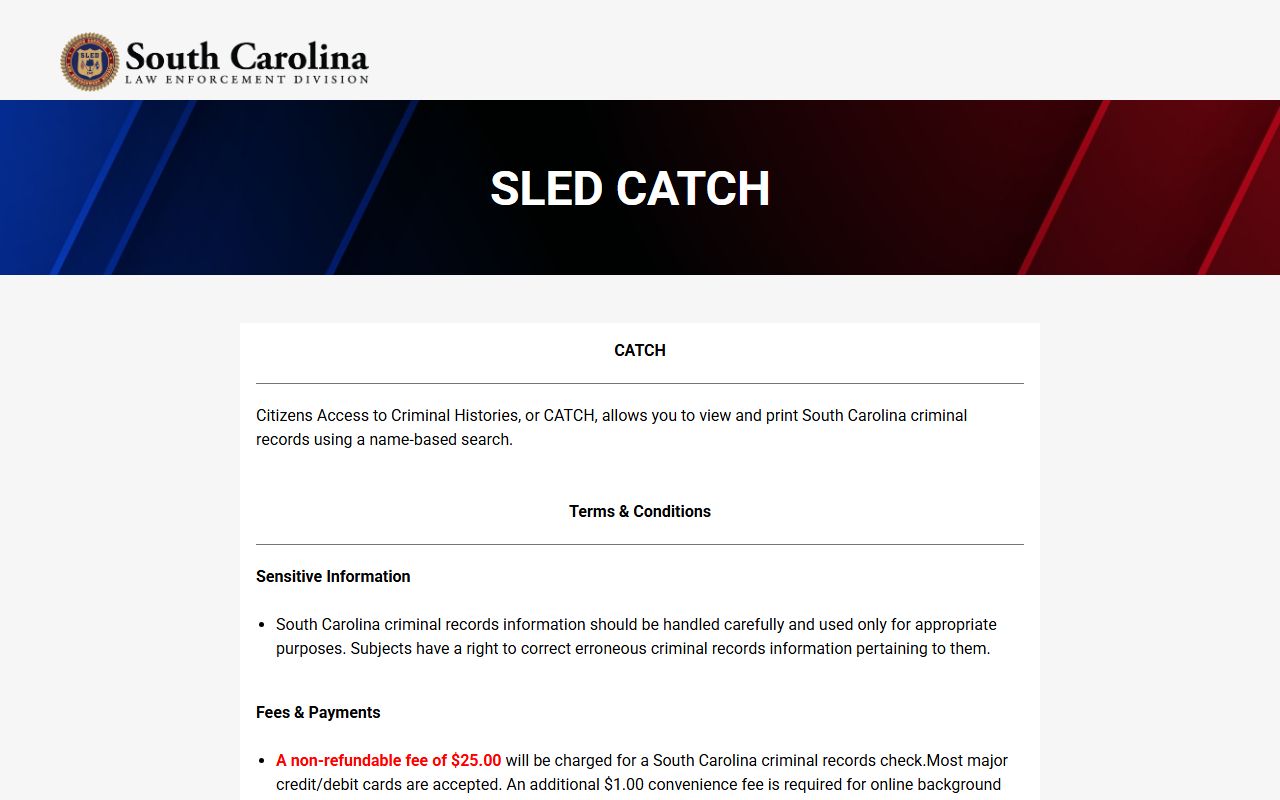
CATCH is useful for statewide criminal-history checks, but SLED states that wanted-person information is not included and that sex offender registry checks use a separate system.
SLED's sex offender registry information page explains the separate registry channel.
The registry can show sex-offender information, but it is not the same as a court charge list, full criminal case record, or active warrant confirmation.
The SLED SORT portal is the direct registry search source.
SORT is relevant only for registry status and should not be used as a substitute for Public Index, Clerk, Magistrate, or Solicitor records.
Background Check Considerations
Court charge records, arrest records, criminal-history reports, and registry records serve different purposes. A court charge record may show an accusation and its status. A criminal court record shows the full case progress and outcome. SLED CATCH is a state criminal-history product with its own search rules and limits. The sex offender registry is a separate statutory registry.
Important: Public lookup information is not an FCRA consumer report and should not be used for regulated screening decisions.
Restricted Charge Records
Juvenile charges and juvenile court records are confidential under South Carolina law except as authorized. Sealed records, expunged records, sensitive family matters, adoption records, and filings with personal identifying information are not ordinary public records. Rule 41.2 requires redaction of personal identifiers, and the Public Index notice says home address information will no longer display as of January 1, 2026.
For McCormick County arrest records that are not online, the practical access chain is direct: Sheriff's Office records or support services, Detention Center for custody questions, Magistrate or Bond Court for warrant/bond events, Clerk of Court for filed General Sessions case records, and county FOIA only where the requested law-enforcement record is legally releasable.
South Carolina court and public-record rules can also narrow what appears in a charge lookup. Juvenile information should not be treated like adult charge data. Expunged charges may be removed from ordinary access. Sealed filings may leave a public docket with limited detail or may not appear in a normal search at all. If the record affects a legal right, get the official answer from the court or agency that created the record.